Wrong Turn, Right Answer: How Your Worst Puzzle Guesses Are Secretly Setting You Up to Win
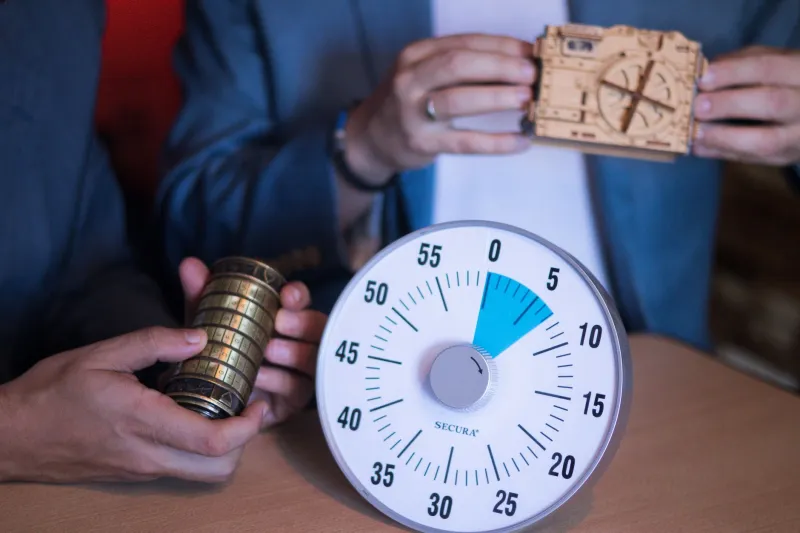
Picture this: You're forty minutes into a sixty-minute escape room in downtown Chicago. Your team has tried every combination that made sense. The logical paths are exhausted. And then, half-joking, your friend punches in a number sequence that seems completely ridiculous — and the lock clicks open.
Everyone laughs. Someone says, "There's no way that should have worked." But here's the thing: it did work. And the reason why might completely change how you think about solving puzzles.
The Myth of the 'Clean' Solve
There's a story puzzle enthusiasts tell themselves — that the best solvers move in straight lines. That mastery looks like confidence, each step deliberate, each guess calculated. Championship puzzle players, the thinking goes, don't waste time on bad ideas.
That story is almost entirely wrong.
Researchers studying problem-solving behavior have found something that feels almost paradoxical: the solvers who generate the most incorrect attempts early in a challenge tend to outperform those who hesitate and overthink before committing to a guess. The act of being wrong — genuinely, confidently wrong — appears to prime the brain for the kind of lateral thinking that produces real breakthroughs.
Dr. Stellan Ohlsson, a cognitive psychologist whose work on representational change theory has influenced puzzle design for decades, described this as the brain needing to "exhaust its first interpretation" before it can see a problem differently. In other words, your brain won't let go of a bad idea until you've actually tested it. The wrong guess isn't a detour. It's a required stop on the route.
Puzzle Designers Who Build Failure Into the Blueprint
If this sounds abstract, spend five minutes talking to the people who actually construct the puzzles you love to solve. Many of them are engineering your failures on purpose.
Marcus Henley, a puzzle designer based in Austin who has built over thirty escape room experiences across Texas, puts it bluntly: "Every room I design has at least two or three what I call 'productive dead ends.' These are paths that look completely viable, draw players in, and then close off. But they're not traps for the sake of cruelty — they're calibrated to reframe how players see the actual solution."
Henley describes one room where a seemingly obvious cipher key leads players to a message that's total nonsense. "People get frustrated for about ninety seconds," he says. "Then something shifts. They start questioning everything they assumed was fixed. That's exactly the mental state where the real puzzle becomes solvable. You can't manufacture that shift without first making someone feel genuinely lost."
This design philosophy has a name in puzzle-making circles: scaffolded misdirection. The wrong path doesn't just waste your time — it dismantles the assumptions that were blocking you from seeing the right path clearly.
Why Your Brain Needs to Fail Out Loud
Here's where the brain science gets genuinely interesting. When you make a guess — even a bad one — you're not just testing an answer. You're encoding a data point. Neurologically, an incorrect attempt activates what researchers sometimes call "prediction error signaling," a process where the brain registers the gap between what it expected and what actually happened.
That gap is uncomfortable. It's also incredibly useful.
Prediction errors force the brain to update its internal model of the problem. Every wrong guess is essentially the brain saying, "Okay, scratch that — now what else could be true?" People who avoid guessing to protect themselves from being wrong are, without realizing it, starving their brains of the very feedback loop that drives insight.
This is part of why puzzles that feel "too fair" can sometimes be less satisfying than ones that genuinely mislead you. The emotional arc matters. Confusion followed by clarity produces a neurochemical reward — specifically a dopamine response — that's measurably stronger than arriving at an answer through a straightforward logical chain. Your brain isn't just solving the puzzle. It's celebrating the recovery.
The Escape Room Confession Nobody Talks About
Spend time in escape room communities — the Reddit threads, the Discord servers, the post-game debriefs at the bar — and a pattern emerges. The stories people retell aren't about the times they solved something efficiently. They're about the times they were completely, embarrassingly wrong before they were spectacularly right.
"We spent fifteen minutes convinced the answer was hidden in a painting," one player from a Seattle-based escape room enthusiast group recalled. "We tried everything with that painting. We almost asked for a hint. And then someone goes, 'What if we've been ignoring the frame this whole time?' We'd been so focused on being wrong about the painting that we stopped seeing the room. The moment we accepted we were wrong, we saw everything differently."
That experience — the pivot from committed failure to sudden clarity — is what puzzle veterans sometimes call "the unlock feeling." It's distinct from simply finding the answer. It's the sensation of a mental model collapsing and rebuilding itself in real time.
How to Fail Better (And Win More)
So what does this mean practically, for anyone who sits down with a riddle, fires up a puzzle game, or books an escape room on a Saturday night?
First, lower the cost of a bad guess in your own head. The biggest obstacle most solvers face isn't the puzzle — it's the internal resistance to committing to an idea that might be wrong. Treat guesses as data collection, not performance.
Second, go loud with your wrong ideas. In group puzzle settings especially, vocalizing a bad theory does double duty: it gets the idea out of your head (where it's taking up mental bandwidth) and it gives your teammates something to react to. Half the time, someone else's reaction to your terrible idea is what sparks the correct one.
Third, notice when you're stuck in a frame. If you've been staring at the same element of a puzzle for more than a few minutes, that's a signal — not that you need to try harder, but that you need to try differently. Deliberately introduce a "wrong" interpretation and follow it somewhere. You might be surprised where it goes.
And finally, trust the designers. If a puzzle has led you somewhere that feels like a dead end, there's a decent chance that dead end was drawn on the map intentionally. The confusion isn't a bug. It's part of the experience — and part of what makes the solution feel so good when it finally arrives.
The Paradox, Unpacked
The puzzle paradox isn't really a paradox once you understand what solving actually is. It's not a process of eliminating wrong answers until only the right one remains. It's a process of becoming someone who can see the right answer — and that transformation requires the friction of failure to happen at all.
Your worst guesses aren't wasted moves. They're the price of admission to the version of your brain that can actually crack the thing.
Next time you're deep in a puzzle and everything feels hopeless, remember: you might just be one terrible guess away from the best solve of your life.