Stress, Solved: Why Millions of Americans Are Using Puzzles as Their Unofficial Therapist
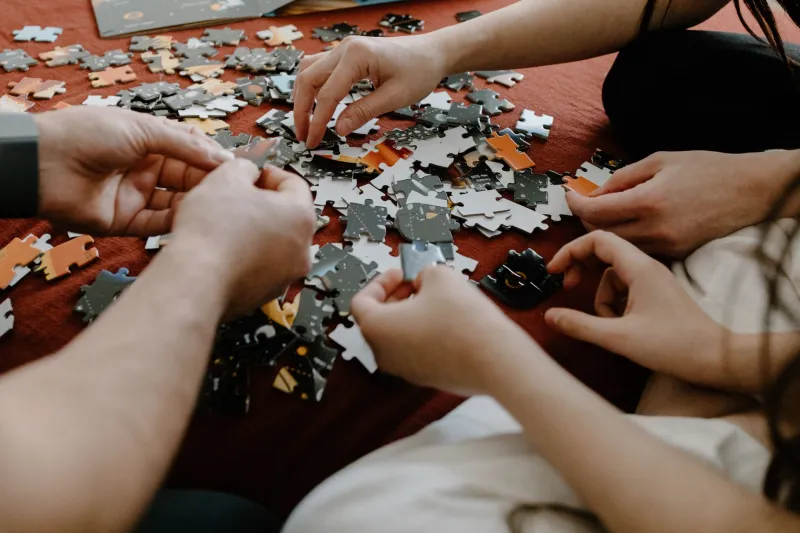
Somewhere between the third news alert of the morning and the fourth unanswered email, a lot of Americans are quietly closing their apps and opening a puzzle instead. Not because they have nothing better to do — but because it might be the best thing they can do.
The numbers back this up. Puzzle sales have surged consistently since 2020, and apps like Wordle, Connections, and various escape-room-style mobile games have racked up hundreds of millions of downloads combined. But this isn't just a hobby trend. Researchers, therapists, and neuroscientists are increasingly treating it like a public health story — one where the prescription might just be a well-crafted riddle.
Your Brain on a Brain Teaser
Here's what actually happens when you sit down with a puzzle. Your prefrontal cortex — the part of your brain responsible for planning and decision-making — kicks into high gear. At the same time, your amygdala, which is essentially your brain's panic button, tends to quiet down. The act of focusing narrowly on a solvable problem pulls your nervous system out of the wide-open, hypervigilant state that chronic stress creates.
Dr. Susan Engel, a developmental psychologist whose work has touched on play and cognition, has described the mental state of puzzle-solving as something close to what Mihaly Csikszentmihalyi famously called "flow" — that absorbed, almost effortless concentration where time seems to dissolve. The difference between flow and plain old distraction, though, is meaningful. Scrolling TikTok might occupy your attention. Solving a logic puzzle structures it.
"There's something uniquely satisfying about a problem that has an answer," says Dr. Marcus Hale, a clinical psychologist based in Chicago who has incorporated puzzle-based exercises into his anxiety treatment practice. "Most of what stresses people out — relationships, finances, the news — doesn't have a clean resolution. Puzzles do. That closure is genuinely therapeutic."
The Meditative Magic of Mystery
It sounds counterintuitive: how does struggling with a hard problem actually relax you? But therapists who work with puzzle-based interventions say the key is the type of mental engagement involved.
Mindfulness meditation works, in part, by giving the mind a single point of focus — a breath, a mantra, a sensation. Puzzles do something structurally similar. When you're untangling a cryptic riddle or working through an escape room challenge, your brain doesn't have the bandwidth to simultaneously rehearse tomorrow's awkward conversation or replay last week's mistake. The puzzle becomes a kind of cognitive container.
Licensed therapist Priya Nair, who runs a wellness practice in Austin, Texas, started recommending jigsaw puzzles and logic games to clients dealing with generalized anxiety disorder about three years ago. "I call it structured distraction," she says. "It's not avoidance — you're still being mentally active — but you're giving your nervous system a break from the open-ended anxiety loop."
She's seen enough anecdotal success that she now keeps a small puzzle kit in her waiting room. Clients who arrive frazzled often settle noticeably before sessions even begin.
The Wellness Industry Takes Notice
The broader wellness world has been slow to embrace puzzles compared to, say, meditation apps or journaling kits — but that's changing fast. Boutique puzzle subscription boxes like Hunt A Killer and various mystery-themed monthly kits have positioned themselves explicitly around stress relief and mindful entertainment. Luxury wellness retreats in places like Sedona and Asheville have started incorporating puzzle rooms and mystery-solving experiences alongside yoga and sound baths.
Even corporate wellness programs — traditionally dominated by gym memberships and mental health hotlines — are experimenting with team-based puzzle challenges as a way to build engagement and reduce burnout. Several major tech companies in the Seattle and San Francisco areas have reportedly added escape-room-style problem-solving sessions to their employee wellness calendars.
The data is getting harder to ignore. A 2023 study published in the journal Applied Cognitive Psychology found that participants who spent 25 minutes working on logic puzzles reported significantly lower self-reported stress levels compared to control groups who spent the same time on social media or watching television. The puzzle group also showed measurably lower cortisol levels — the hormone most directly associated with stress.
Why the "Solve" Moment Hits Different
Ask anyone who's cracked a tough puzzle and they'll describe a very specific feeling: a sudden release, a little burst of satisfaction that's almost physical. That's dopamine — the neurotransmitter your brain releases in response to reward. And it turns out the anticipation of solving, not just the solution itself, is enough to trigger that response.
This is why puzzle designers talk about "the hook" — that moment early in a challenge where you feel like you almost have it, where the answer seems just out of reach. That tension, neurologically speaking, is pleasurable. It keeps you engaged without tipping into frustration. The best riddles and brain teasers are calibrated to live right in that sweet spot.
For people dealing with anxiety, that dopamine loop has another benefit: it's a reminder that effort produces results. Anxiety, by contrast, often involves effort that produces nothing — worrying without resolution, planning without control. Puzzles offer a small but meaningful counter-narrative: try this, get somewhere.
So, Should You Actually Try It?
If you're already a puzzle person, this probably feels like validation. If you're not, it might be worth a low-stakes experiment. You don't need to commit to a thousand-piece jigsaw or a subscription box. Start with a daily word game, a five-minute logic riddle, or even a mystery podcast that asks you to solve along.
The goal isn't to become a competitive puzzle champion. It's just to give your brain a different kind of workout — one where the problem has edges, the answer exists, and the only thing you have to figure out is this, right here, right now.
In a world that rarely offers clean solutions, that's not a small thing. That might actually be everything.