Why You Can Crack a Cold Case But Can't Decode Your Own Relationship
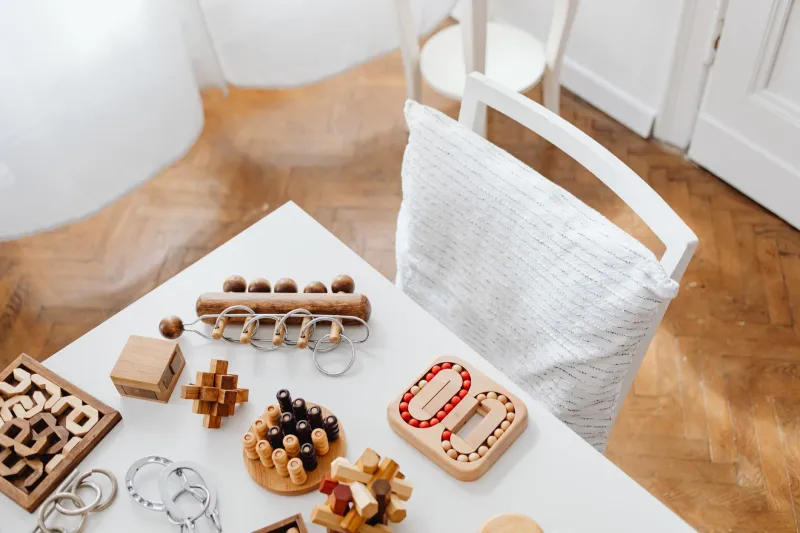
Let's set the scene. You've just crushed a Saturday night escape room — deciphered the cipher, spotted the hidden compartment, connected every clue in the right order, and walked out with three minutes to spare. You're feeling sharp. Unstoppable, even.
Then Sunday rolls around, and your partner is clearly upset about something. You ask what's wrong. They say "nothing." And suddenly, the person who just solved twelve interconnected puzzles in under an hour is completely, utterly lost.
Sound familiar? You're not alone — and you're definitely not broken. There's actually a well-documented psychological explanation for why puzzle-trained brains can feel so helpless in the middle of real human conflict. And understanding it might be the most useful thing you solve all year.
The Brain Loves a Closed System
Here's the thing about puzzles — every single one of them, from crosswords to murder mysteries to escape rooms, is a closed system. That means there's a defined set of rules, a finite number of variables, and — crucially — a correct answer waiting at the finish line. The puzzle designer put it there. Your job is to find it.
Your brain absolutely thrives in that environment. It's like handing a bloodhound a scent trail that leads directly to the hiding spot. Every clue has a purpose. Every detail was placed intentionally. There's no noise, no irrelevant information, and no possibility that the answer simply doesn't exist.
Relationships, on the other hand? Open system. Wildly, chaotically, gloriously open. The "clues" your partner gives you aren't planted by a puzzle designer with a solution in mind. Their behavior is shaped by childhood experiences you don't know about, a stressful week at work, something they half-heard on a podcast, and approximately a thousand other invisible inputs. There is no answer key.
Dr. Priya Mehta, a cognitive psychologist based in Chicago who studies decision-making and pattern recognition, puts it this way: "Puzzle solvers are trained to assume that information is meaningful and intentional. In real life, a lot of human behavior is neither. When someone who's great at puzzles encounters ambiguity in a relationship, they often do what their brain is wired to do — they start pattern-matching and constructing a narrative. Sometimes that narrative is completely wrong, but it feels right because it's internally consistent."
In other words, your puzzle brain can build a very convincing story out of very unreliable data.
The Confirmation Trap
Escape room veterans know the danger of fixating on one theory too early. You latch onto an idea, start filtering every new clue through it, and before long you've talked yourself into a dead end. Good puzzle designers actually exploit this tendency — it's called a "red herring," and it works because our brains want to commit to a hypothesis.
In relationships, this same cognitive trap plays out constantly. You decide your friend is annoyed at you because of something you said last week. Now everything they do — the short text reply, the cancelled plan, the slightly flat tone on a phone call — gets filed under "proof" of that theory. You're no longer reading the situation. You're confirming a story you already wrote.
Marco, a 34-year-old puzzle enthusiast and software engineer from Austin who asked that his last name not be used, described exactly this dynamic. "I'm really good at building logical frameworks. Like, I can look at a set of variables and construct a model pretty fast. The problem is I started doing that with people in my life. I'd decide what was going on with someone and then just... collect evidence for it. My therapist finally pointed out that I wasn't actually listening to anyone — I was just auditing them against my theory."
He laughed when he said it, but the cost was real. He'd drifted from two close friendships before he caught the pattern.
When Logic Is the Wrong Tool
Puzzles reward deductive reasoning. You eliminate what's impossible, and whatever remains — however improbable — must be the truth. It's elegant. It's satisfying. And in the context of a well-designed brain teaser, it works every time.
But human beings aren't logic problems. They're contradictory, emotionally driven, and frequently unaware of their own motivations. Applying strict deductive logic to a grieving friend or a frustrated spouse doesn't just fail — it can actively make things worse. Because the other person doesn't experience your careful reasoning as helpful. They experience it as cold. Clinical. Like being cross-examined instead of heard.
"The biggest mistake I see in high-achieving analytical thinkers is that they try to solve emotional situations," says Dr. Mehta. "Emotions don't want to be solved. They want to be witnessed. The moment you shift into problem-solving mode with someone who's hurting, you've already missed the point."
This is the puzzle-life mismatch in its starkest form. The very instinct that makes you excellent at decoding mystery novels — the drive to fix and resolve — can make you emotionally unavailable in the moments that matter most.
The Skills That Actually Transfer
None of this means your puzzle brain is useless in relationships. Far from it. It just means the right skills need to be brought to the surface — and some of the dominant ones need to be deliberately quieted.
Patience, for instance, transfers beautifully. Anyone who's spent forty minutes on a single clue without rage-quitting knows how to sit with discomfort and resist the urge to force an answer. That's a wildly underrated relationship skill.
So does the ability to hold multiple hypotheses at once — a technique experienced solvers use when the evidence is ambiguous. Instead of committing to one interpretation of someone's behavior, you can practice staying genuinely open. "Maybe they're upset. Maybe they're just tired. Maybe it has nothing to do with me." That's not weakness. That's intellectual honesty.
And curiosity — the thing that makes a great puzzle solver lean in when something doesn't make sense — is one of the most powerful tools in any relationship. Not the interrogative kind of curiosity that's really just information-gathering for your theory. The genuine kind. The kind that asks questions because you actually want to understand another person, not because you're building a case.
Marco says that reframe changed everything for him. "I started treating conversations like I was exploring a new puzzle rather than solving a known one. Like, I don't actually know what's going on here — let me find out. It sounds simple, but it was genuinely different from what I was doing before."
The Hardest Puzzle You'll Ever Attempt
Here's the uncomfortable truth that every puzzle lover eventually bumps into: the people in your life are the most complex, unpredictable, and rewarding mysteries you'll ever encounter. They don't come with solution manuals. They change. They surprise you. They sometimes don't even understand themselves.
That's not a design flaw. That's what makes them worth knowing.
The puzzle brain that serves you so well in a game room doesn't need to be abandoned in real life — it just needs a software update. Less solution-hunting, more genuine exploration. Less confirmation, more curiosity. Less closing the loop, more staying open to the mess.
Because the best solvers — in puzzles and in life — know when to put down the rulebook and just pay attention.