Your Favorite Puzzle Type Is Basically a Map of Your Blind Spots
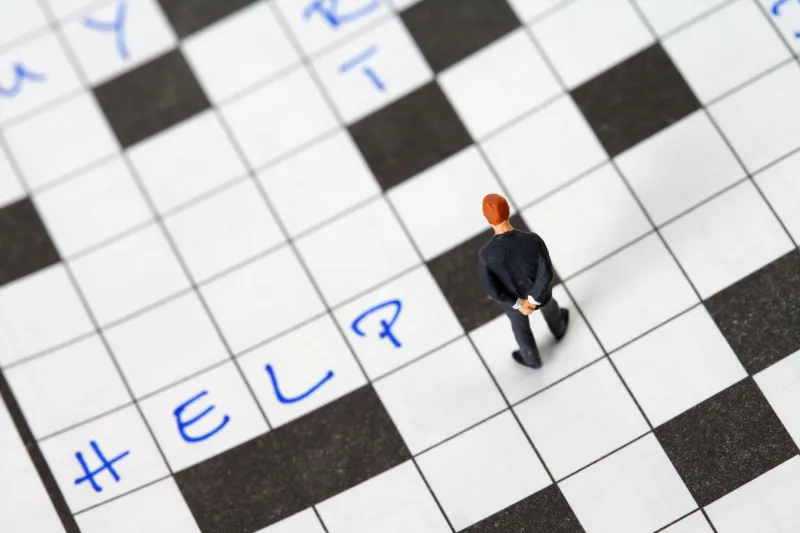
Here's a question worth sitting with: Why do you always go back to the same kind of puzzle?
Not the surface-level answer — "I like logic grids" or "wordplay is just fun." The deeper one. Because the pattern of what you're drawn to, what you're good at, and what you keep choosing to practice says something specific about how your brain is wired. And here's the part that might sting a little: it also says something specific about where your brain reliably lets you down.
This isn't a hot take. It's backed by a growing body of neuroscience research on cognitive specialization, and it has some genuinely uncomfortable implications for anyone who considers themselves a serious solver.
The Puzzle Preference Pattern
Most dedicated puzzle enthusiasts, when pushed to be honest, admit they have a type. Code-breakers who light up at ciphers. Word nerds who can't resist a cryptic crossword. Visual thinkers who gravitate toward spatial puzzles and mazes. Logic devotees who live for the methodical elimination of a grid puzzle.
These preferences aren't random. They map onto distinct cognitive profiles — ways that different brains process, organize, and retrieve information.
Dr. Kenji Watanabe, a neuroscientist at a research university in the Midwest who studies decision-making and problem-solving, explains it this way: "The puzzles you find most satisfying tend to activate the same neural networks that you rely on most heavily in daily life. You're drawn to them because they feel natural. And they feel natural because they're reinforcing something your brain already does well."
The flip side of that? The puzzle types that feel frustrating, boring, or just not interesting to you? Those are often pointing at the cognitive muscles you're not using.
Four Types, Four Blind Spots
Let's get specific. Here's how the major puzzle preference categories tend to map onto real-life decision-making patterns — and where each type tends to stumble.
The Logic Grid Devotee
If you love logic grids — those satisfying matrices where you eliminate possibilities until only one solution remains — you're likely a systematic, sequential thinker. You're good at holding multiple variables in mind, following chains of reasoning, and not jumping to conclusions.
Your blind spot: situations that require intuitive or emotionally-informed decisions. Logic grids work because every piece of information is given to you. Real life doesn't do that. Logic grid thinkers can get stuck waiting for complete information before acting, or they can miss the human, emotional dimension of a problem entirely because it doesn't fit neatly into their framework.
The Wordplay Enthusiast
Cryptic crosswords, anagrams, puns, riddles built on double meanings — if this is your zone, you're likely a highly associative thinker with a strong feel for context, ambiguity, and the way meaning shifts depending on framing. You're excellent at reframing problems.
Your blind spot: precision and follow-through. Wordplay brains are fantastic at generating possibilities and finding unexpected angles. They're sometimes less strong at committing to a single answer and executing on it systematically. In real life, this can show up as a tendency to reframe a problem creatively rather than solving it directly.
The Code-Breaker
Ciphers, encryption puzzles, pattern-based decoding — this type tends to attract people who are deeply motivated by hidden structure. You believe there's an underlying system, and you won't rest until you find it.
Your blind spot: accepting that some things genuinely don't have a hidden pattern. Code-breaker brains can find themselves manufacturing meaning in random noise — seeing conspiracies in coincidences, reading intent into accidents, or spending enormous energy searching for a system that simply isn't there. In relationships and organizational dynamics, this can lead to significant misreadings.
The Spatial Puzzle Solver
Mazes, 3D puzzles, tangrams, physical manipulation challenges — if you love working with shape, space, and rotation, you likely have a strong capacity for mental visualization and non-verbal reasoning.
Your blind spot: verbal and interpersonal complexity. Spatial thinkers often prefer working with objects and systems over people and language. In real-life situations that require nuanced communication, negotiation, or reading social dynamics, the spatial brain can find itself genuinely lost — not because it's not smart, but because those domains don't map onto its preferred mode.
The Comfort Zone Trap
Here's where it gets a little uncomfortable. Most solvers, even very skilled ones, tend to spend the majority of their puzzle time in their preferred domain. They get better and better at the thing they're already good at — and they quietly neglect everything else.
This is completely understandable. Competence feels good. Struggling feels bad. And when puzzle-solving is your leisure activity, the last thing you want is to feel incompetent.
But the research on cognitive flexibility — the ability to switch between different thinking modes — suggests that exclusive specialization comes with real costs. A study on expert problem-solvers found that high performance in one reasoning domain was frequently accompanied by measurably lower flexibility when problems required a different cognitive approach. The brain, essentially, gets very good at running one playbook and starts defaulting to it even when it doesn't fit.
Sarah, a 41-year-old attorney in Seattle who describes herself as a "logic puzzle obsessive," recognized this pattern in herself after a conversation with a therapist. "She pointed out that I approach every conflict in my personal life like a logic grid — I'm looking for the provably correct answer. But relationships don't work that way. There isn't always a correct answer. And my insistence on finding one was making everything harder."
Using Your Puzzle Pattern as a Diagnostic
The point here isn't to make you feel bad about your favorite puzzle type. It's to suggest that your preferences are data — and data is useful.
If you know you're a logic grid devotee, you can start practicing decisions that require acting on incomplete information. If you're a wordplay brain, you can practice committing to a single interpretation and following through. If you're a code-breaker, you can practice sitting with randomness. If you're a spatial thinker, you can invest in verbal and interpersonal challenges.
And you can do all of this through puzzles. That's the beautiful part. The same mechanism that built your strength can build your flexibility — if you're willing to deliberately step outside your comfort zone.
Try a puzzle type that frustrates you. Sit with the discomfort. Notice what feels hard.
That friction? That's the clue. That's where the real solve is waiting.