The DMV Is an Escape Room With Bad Lighting: Design Lessons From American Bureaucracy
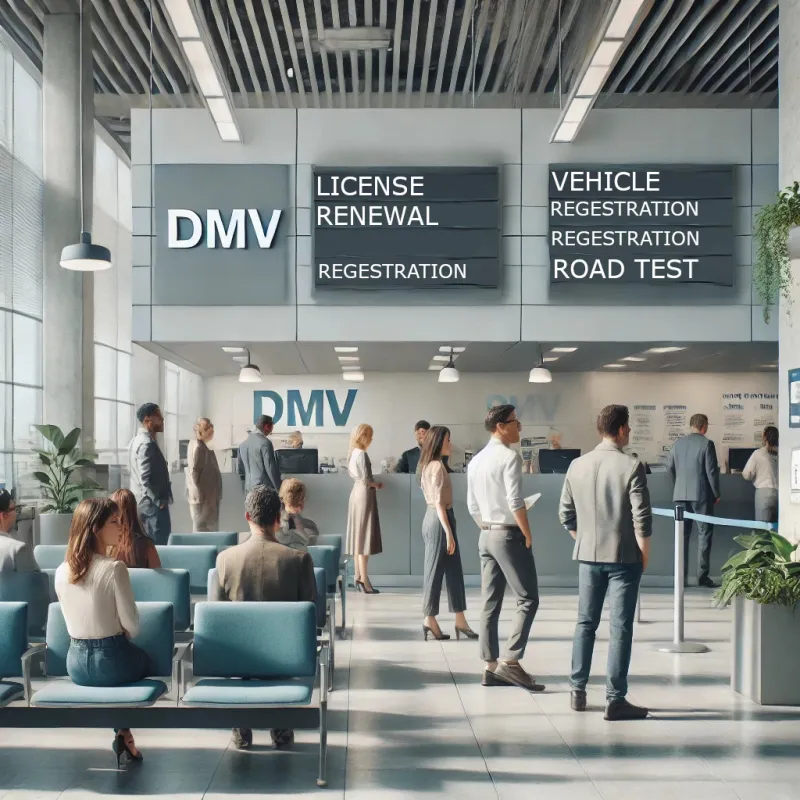
Photo: DMV waiting room number screen American office, via safedriversacademy.com
The DMV is an escape room. It has a waiting room, a series of locks, a set of rules nobody explains, and a final door that opens only when you have the right combination of documents. The decor is worse. The clues are printed in six-point font. The game master is a numbered screen that calls you to a window you did not expect. And unlike a real escape room, you cannot ask for a hint without risking a new form.
The DMV as an accidental puzzle
Think about the structure. You arrive with a goal: renew a license, register a car, replace a title. You are given a form that references another form. You wait. You are called. You are told you need a document you did not bring. You go back. You wait again. Eventually, if you are lucky, the final lock clicks and you leave with a sticker, a card, or a piece of paper that proves you solved the level.
That is not a coincidence. Bureaucracy is a system of gates. Each gate has a condition. Each condition has a document. The problem is that the system rarely explains the logic. It gives you the lock but not the clue. It gives you the waiting room but not the map. It gives you a rule but not the reason.
Why bureaucracy feels like a badly designed escape room
A good escape room teaches you its language. A bad one punishes you for not already knowing it. The DMV often feels like the second kind. The instructions are incomplete. The signs point to a general area, not a specific window. The forms use the same word for two different things. The feedback is delayed, vague, or delivered by a person who is as tired of the puzzle as you are.
There are also arbitrary locks. You need a proof of address, but not the one you brought. You need a signature, but not the one you gave. You need an appointment, but the appointment system has no openings for six weeks. In puzzle design, a lock is only fair if the player can deduce the key. In bureaucracy, the lock often depends on a rule that exists only in a training manual.
Then there are the red herrings. The website says one thing. The phone line says another. The person at the window says a third. None of them are lying, exactly. They are operating from different versions of the same puzzle. That is a design failure, not a mystery.
The accidental training ground
Here is the twist: bad bureaucracy also trains puzzle-like thinking. You learn to read fine print. You learn to sequence tasks. You learn to ask a precise question instead of a vague one. You learn that the first answer is not always the final answer. You learn to keep copies, take notes, and document the solve.
That is not nothing. Everyday problem-solving often looks like this: an unclear goal, incomplete information, and a system that does not care whether you succeed. The people who thrive are not always the smartest. They are the ones who slow down, read the instructions, and ask for the right clue.
Design lessons for escape-room creators
First, make the objective obvious. The player should know what winning looks like before the first lock. The DMV often fails this. A good escape room does not.
Second, use progressive disclosure. Give one clue at a time. Do not dump a folder of forms on the table and call it atmosphere. Let the puzzle unfold.
Third, make locks meaningful. A combination should be deducible from the information in the room. A lock that requires outside knowledge is not a puzzle; it is a trivia question with a time limit.
Fourth, provide feedback. When a player tries a wrong code, tell them it is wrong. When they solve a step, show them what changed. Silence is not suspense. Silence is confusion.
Fifth, use signage that helps. A sign should answer a question the player already has. It should not send them to a window that is closed.
Sixth, avoid red herrings without payoff. A false clue can be fun if it later makes sense. A false clue that leads nowhere is just noise.
Seventh, design for reset and accessibility. Players will make mistakes. They will need a clean slate. They will need clear text, good lighting, and a way to ask for help without feeling stupid.
Eighth, end with a clear release. The final door should feel earned. The player should know they solved it, not just survived it.
Lessons for everyday problem-solvers
When you are stuck in a bureaucratic puzzle, treat it like a room. Write down the goal. List the locks. Find the clues. Ask for the rule, not just the answer. Take a photo of every document. Keep a timeline. And if the system gives you a dead end, look for the side door: a different form, a different office, a different phone number, or a patient human who knows the map.
Do not overcomplicate it. Most bureaucratic puzzles are not deep. They are poorly explained. The solve is often boring: read the fine print, bring the right paper, and come back on a Tuesday morning.
Better decor, same mystery
The DMV will never be a great escape room. The lighting is bad, the wait is long, and the final prize is a laminated card. But it is a useful reminder that puzzle design is everywhere. A good puzzle respects the player. A bad one hides the rules. The difference is not the number of locks. It is whether the solver has a fair chance to see the pattern.
So the next time you are stuck in a waiting room with a numbered screen and a form you do not understand, take a breath. You are not just running an errand. You are playing a very slow, very beige escape room. The trick is to find the clue before your number is called.