When Puzzle Logic Becomes a Trap: The Hidden Cost of Overthinking Real Life

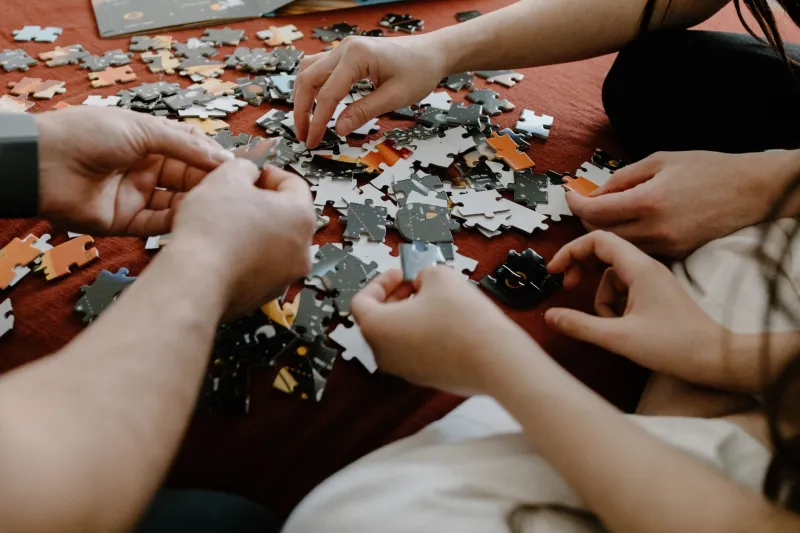
Photo by Photo by J. Balla Photography on Unsplash on Unsplash
There's a particular kind of frustration that puzzle lovers know intimately. It's not the frustration of being stumped — that's actually kind of fun. It's the frustration of staring at something that should have a solution, applying every tool in your mental arsenal, and still coming up empty. The worst part? Sometimes the thing you're staring at isn't a puzzle at all.
It's just... life.
The Brain That Can't Stop Hunting for Clues
Here's the thing about puzzle training: it works. Consistently working through brain teasers, escape rooms, logic grids, and lateral thinking challenges genuinely rewires how your mind processes information. Researchers at Johns Hopkins and other institutions have documented how repeated puzzle engagement strengthens pattern recognition, sharpens deductive reasoning, and builds what cognitive scientists sometimes call "inferential confidence" — the belief that hidden structures exist and can be found.
That's great news when you're staring down a cryptic crossword or navigating a murder mystery dinner. It becomes a problem when you're trying to figure out why your coworker seemed cold at lunch, or why your partner has been quiet all week.
The puzzle-trained brain doesn't naturally distinguish between a riddle and a relationship. Both arrive as incomplete information. Both trigger the same neural itch. And so the brain does what it's been trained to do: it starts hunting for the hidden mechanism.
Clues That Aren't Clues
Clinical psychologists have a term for this tendency when it goes sideways — "apophenia" — the experience of perceiving meaningful connections between unrelated things. Most people associate it with conspiracy theories or certain psychiatric conditions. But a milder, more socially acceptable version shows up constantly in high-functioning puzzle enthusiasts.
You notice your friend didn't respond to your text for four hours. A puzzle brain immediately begins cataloging: What changed recently? What was the last thing I said? Is this a pattern? By the time your friend replies with "sorry, was in a meeting," you've already constructed three competing theories about the state of your friendship.
The information was always incomplete. The puzzle brain filled in the gaps with logic. The logic was technically sound. And it was still completely wrong — because the situation wasn't a puzzle. It was just Tuesday.
"There's a real cognitive cost to treating ambiguity as a solvable problem," says Dr. Maya Okonkwo, a behavioral psychologist based in Chicago who works with high-achieving clients. "People who are very good at structured problem-solving often have the hardest time tolerating situations that are genuinely uncertain. They interpret that discomfort as a signal that they haven't found the right angle yet."
The Paranoia Pipeline
This is where things get psychologically interesting — and a little uncomfortable.
Puzzle logic operates on a foundational assumption: there is a correct answer, and it can be reached through the right sequence of steps. That assumption is almost always true in designed challenges. Someone built the escape room. Someone wrote the riddle. The solution exists.
Real life doesn't come with a designer. Your job situation, your health anxiety, your complicated family dynamics — none of these were constructed with a satisfying resolution in mind. But a brain trained on puzzles doesn't fully internalize that distinction. It keeps looking for the mechanism. And when it can't find one, it doesn't conclude that no mechanism exists. It concludes that the mechanism is hidden.
That's the paranoia pipeline. The inability to find a solution becomes evidence of concealment. The absence of a clear clue becomes a clue in itself. What started as healthy analytical thinking quietly curdles into suspicion.
Psychologists call this "hyperactive agency detection" — the tendency to assume intentional causation behind random or neutral events. It's not unique to puzzle people, but their particular brand of it is sharpened by years of practice finding the thing that was deliberately hidden.
When Acceptance Is the Answer
Here's the hardest clue for any solver to accept: sometimes the answer is that there is no answer.
Not every awkward conversation has a hidden meaning. Not every run of bad luck is a pattern waiting to be decoded. Not every difficult relationship is a puzzle that just needs the right key. Some situations are genuinely messy, ambiguous, and resistant to resolution — not because the solution is buried deeper, but because they were never structured problems to begin with.
Therapists who work with anxious high-achievers often describe a specific treatment goal: helping clients develop what's called "tolerance for ambiguity." It's the ability to sit with uncertainty without immediately converting it into a problem-solving exercise. For puzzle lovers, this can feel almost physically uncomfortable. The itch to analyze is that strong.
But here's the reframe that actually helps: recognizing when you're solving versus when you're suffering. Puzzles are supposed to be fun. The moment your analytical brain starts making you miserable — second-guessing friendships, catastrophizing workplace dynamics, replaying conversations for hidden meaning — that's not solving. That's the puzzle eating you.
The Solve You Actually Need
None of this means puzzle thinking is bad. It means it's a tool, and like any tool, it needs to be picked up and put down deliberately.
The most sophisticated puzzle solvers eventually develop a kind of meta-awareness: the ability to assess before diving in whether a situation actually warrants systematic analysis. Is this a structured problem with a discoverable solution? Or is this a human moment that needs presence, not analysis?
That distinction — knowing when to solve and when to simply be — might be the most advanced puzzle of all. And unlike the ones in your favorite app, cracking it doesn't come with a satisfying chime and a score. It comes with something quieter and harder to measure: a little more peace.