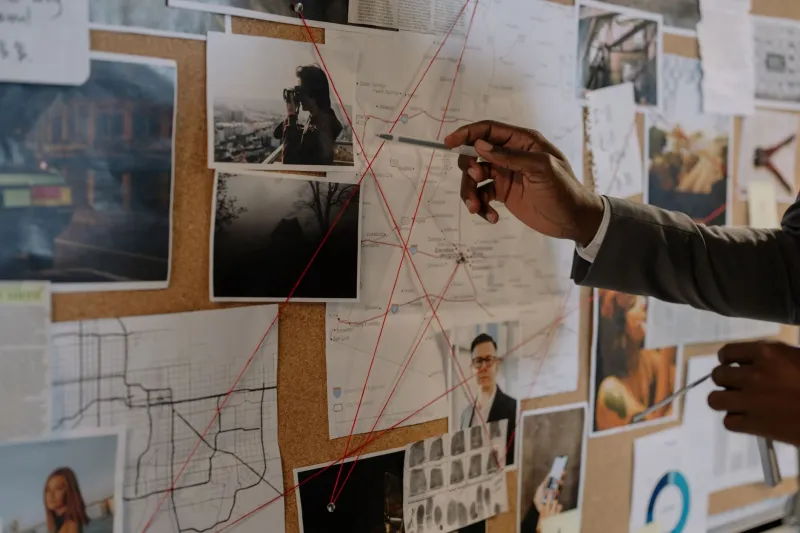
When Every Coincidence Becomes a Clue: The Dark Side of Being Too Good at Spotting Patterns

Let's say you've spent years getting genuinely great at puzzles. Escape rooms, cryptic crosswords, ARGs, murder mysteries — you've cracked them all. Your brain has been trained, rep by rep, to assume that nothing is random. Every detail means something. Every clue is placed with intention. The universe, at least inside a puzzle, is perfectly designed.
Now let's say you walk back into the real world with that brain.
For a surprising number of dedicated puzzle enthusiasts, that transition doesn't go smoothly. The mental habits that make someone a brilliant problem-solver can — under the right (or wrong) conditions — start warping how they interpret everyday life. A friend's oddly timed text. A news headline that rhymes with something you saw last week. A logo that looks just like another logo you noticed three months ago.
Suddenly, you're not relaxing. You're investigating.
The Brain That Can't Clock Out
Psychologists have a name for the underlying mechanism: apophenia — the tendency to perceive meaningful connections between unrelated things. It's a completely normal cognitive function, and in small doses, it's actually useful. Evolution rewarded the ancestors who assumed that rustling bushes might mean a predator, not just wind.
But puzzle culture can turbocharge apophenia in ways that get uncomfortable fast.
"When you spend hundreds of hours in environments where patterns are always meaningful, your brain starts recalibrating its baseline," explains Dr. Renee Calloway, a cognitive psychologist based in Chicago who has worked with patients experiencing anxiety tied to compulsive pattern-seeking. "The brain is an incredibly adaptive organ. Train it to find hidden messages, and it will find hidden messages — even when none exist."
This isn't a fringe issue. Online forums dedicated to puzzle games and ARGs are full of threads where participants openly wonder whether they've "broken" their own thinking. One Reddit user in a popular escape room community wrote: "I spent 45 minutes convinced my roommate's grocery list was a coded message because the first letters spelled something. It wasn't. I need help." The post had over 2,000 upvotes.
From Puzzle Boards to Conspiracy Boards
Here's where it gets genuinely uncomfortable: the cognitive leap from "I'm great at finding hidden patterns" to "the patterns I'm finding are real and important" is smaller than most people realize.
Researchers at the University of Amsterdam published findings suggesting that people who score high on pattern recognition tasks are also statistically more susceptible to conspiratorial thinking — not because they're less intelligent, but because their brains are better at constructing coherent narratives out of incomplete information. That's a feature in a puzzle. In daily life, it can become a bug.
Marcos D., a 34-year-old software developer from Austin who describes himself as a "recovering ARG addict," knows this firsthand. He spent about two years deeply embedded in alternate reality games — the kind where designers scatter cryptic clues across websites, phone numbers, and social media accounts for players to decode collectively.
"The problem is that ARGs train you to believe that everything is part of the game," he told us. "Designers call it 'the curtain' — the line between the game world and reality. After a while, I couldn't find the curtain anymore. I started analyzing my coworkers' Slack messages for hidden meanings. I thought a billboard near my apartment was a clue someone had planted for me specifically. My girlfriend at the time was genuinely worried."
Marcos eventually stepped back from puzzle communities entirely for about eight months. He describes the process of "recalibrating" as surprisingly difficult — almost like breaking a habit of thought rather than a habit of behavior.
The Thin Line Between Sharp and Suspicious
What separates a healthy puzzle brain from one that's gone sideways? Dr. Calloway points to a few key markers.
Healthy pattern recognition tends to be context-aware. You know you're playing a game. You know the puzzle has boundaries. When you step outside those boundaries, the puzzle-brain switches off — or at least quiets down.
Problematic pattern recognition loses that contextual awareness. The search for meaning bleeds into spaces where it doesn't belong: personal relationships, news consumption, social media, even dreams. And critically, the person experiencing it often feels a reward from the searching itself — a dopamine hit that keeps them looking even when nothing is there.
"It can mimic OCD in some ways," Dr. Calloway notes. "The searching feels productive and even pleasurable in the moment, but it's exhausting and ultimately distressing. People often describe feeling like they have to keep looking, even when they don't want to."
Social media has made this dramatically worse. Platforms like X (formerly Twitter), Reddit, and TikTok are essentially infinite puzzle boxes — full of fragmented information, suggestive juxtapositions, and communities that actively reward people for connecting dots. For someone whose brain is already primed to hunt for hidden structure, the scroll can become an investigation that never ends.
Learning to Turn It Off
The good news: it's a learnable skill. Puzzle enthusiasts who've navigated this successfully tend to describe a similar process — deliberately building what one escape room designer called "context walls" around their puzzle thinking.
That means creating clear mental (and sometimes physical) rituals that signal the start and end of puzzle mode. It means practicing what therapists sometimes call cognitive defusion — noticing the pattern-seeking thought without automatically acting on it. "My brain is doing the thing again" rather than "This must mean something."
Marcos now keeps a running note on his phone. When he notices himself reading hidden meaning into something mundane, he writes it down — and then deliberately does nothing with it. "Most of the time, when I look at the list a week later, I can see how absurd it was," he says. "But in the moment, it felt completely real and urgent. The list helps me remember that the feeling isn't the same as the fact."
For others, the fix is simpler: more puzzle time, not less — but structured puzzle time with clear endpoints. Giving the pattern-hungry brain a legitimate outlet can reduce the pressure that pushes it into everyday life.
The Clue That's Actually a Mirror
There's something almost poetic about this particular puzzle. The very trait that makes someone exceptional at games — the refusal to accept randomness, the compulsive search for order — is also the trait that can quietly unravel the life surrounding those games.
The real mystery isn't hidden in a cipher or an escape room lock. It's in understanding your own brain well enough to know when your greatest skill is working for you, and when it's quietly working against you.
So next time you catch yourself analyzing a stranger's coffee order for hidden significance — take a breath. Close the case file. Some things really are just coincidence.
And honestly? That's kind of a relief.