Heist Brain: How Crime Movies and Mystery Shows Actually Made You a Better Puzzle Solver
Your Couch Was a Classroom This Whole Time
Let's make a deal: you stop feeling guilty about the six hours you spent rewatching Knives Out last weekend, and we'll explain exactly why that was a legitimate cognitive workout.
Because here's the thing — the way mystery movies and heist shows structure their storytelling isn't just entertainment design. It's a masterclass in applied logic, pattern recognition, and lateral thinking. The same mental moves that Benoit Blanc pulls off in a parlor room are the moves that escape room champions use when they're staring at a combination lock with three minutes left on the clock.
Some of it translates directly. Some of it is pure Hollywood magic that would get you laughed out of a puzzle competition. Knowing the difference? That's where the real skill lives.
The Deduction Scene — More Real Than You Think
Almost every detective story has one: the moment where the protagonist stands in front of a crowd and unspools the entire solution from a chain of logical inferences. Poirot does it. Sherlock does it. Even Jake Peralta on Brooklyn Nine-Nine does a version of it.
It looks theatrical. And honestly, the delivery is theatrical. But the underlying cognitive process — working backward from a known outcome to reconstruct a sequence of causes — is a legitimate problem-solving technique called retrograde analysis, and it's used extensively in competitive puzzle solving.
In escape rooms, retrograde analysis sounds like: "The combination has to be four digits. The only four-digit number referenced in this room is the year on the newspaper prop. Let's test that." You're not guessing forward randomly; you're reasoning backward from the structure of the solution.
When Sherlock Holmes (in any of his many screen incarnations) rattles off a chain of deductions from a single observation, the content is obviously exaggerated. But the method — observe a specific detail, form a hypothesis, test it against other available evidence — is exactly how skilled puzzle solvers work. The BBC version of Holmes even makes this explicit: he doesn't just guess, he eliminates. Sound familiar? It should, because we talked about that same principle in the context of dead ends.
The Heist Planning Sequence: A Masterclass in Constraint Mapping
If detective stories teach retrograde analysis, heist movies teach something equally valuable: constraint mapping.
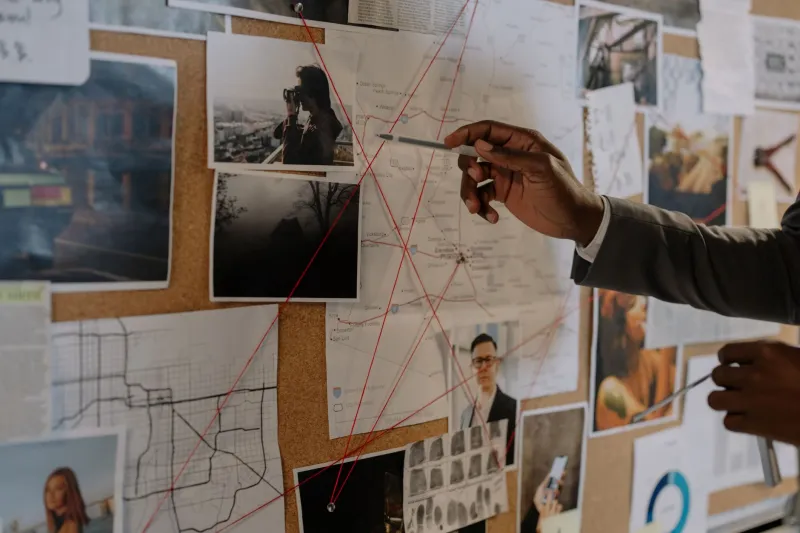
Think about the planning montage in Ocean's Eleven. The crew doesn't just decide to rob the casino and walk in. They spend the first act systematically identifying every constraint — the vault's time lock, the guard rotation, the backup power system — and building a plan that threads through all of them simultaneously. Each constraint isn't a reason to quit; it's a variable that shapes the solution.
This is exactly how experienced puzzle solvers approach complex multi-step puzzles. Instead of charging at the final answer, they map the constraints first. What's fixed? What's flexible? What information do you have, and what's still missing? The heist crew in almost any competent Hollywood thriller is doing applied systems thinking — they just do it while wearing very stylish suits.
The constraint mapping approach is especially powerful in logic puzzles and escape rooms with interconnected mechanisms. Players who try to brute-force solutions ("let's just try every combination") almost always lose to players who spend two minutes identifying what the puzzle can't be before trying what it might be.
What Hollywood Gets Completely Wrong
Okay, let's be honest about the fantasy parts.
The eureka moment. In movies, the detective suddenly sees the answer — a flash of insight triggered by a random detail, usually accompanied by a dramatic music sting. In reality, insight moments do happen, but they almost always come after sustained, methodical work. The "aha" is the payoff of the process, not a substitute for it. Waiting around for inspiration in an escape room will eat your clock alive.
The lone genius. From Sherlock to Mindhunter, pop culture loves the solitary brilliant mind who cracks the case while everyone else flounders. In actual puzzle competition data, team-based solving consistently outperforms solo approaches on complex problems — because diverse perspectives catch blind spots. The lone genius makes for great TV. In a real puzzle room, you want your team talking.
The villain who overcomplicates everything. Mystery plots often hinge on an antagonist who creates an absurdly elaborate scheme when a simpler one would have worked better. This is called narrative necessity in screenwriting — the complexity exists to give the detective something to unravel. Real puzzles are complex for structural reasons, not dramatic ones. Don't go hunting for hidden layers that aren't there just because a movie taught you to expect them.
True Crime's Unexpected Gift to Puzzle Thinkers
Here's a category that doesn't get enough credit: true crime content — podcasts, docuseries, investigative journalism — is genuinely training its audience in probabilistic reasoning.
Shows like The Jinx, Making a Murderer, and the investigative episodes of Dateline walk viewers through the process of weighing evidence, accounting for alternative explanations, and updating conclusions as new information emerges. That's not just compelling storytelling — it's a tutorial in Bayesian thinking, the practice of adjusting your confidence in a hypothesis based on new data.
For puzzle solvers, this translates directly. The player who can hold multiple competing theories simultaneously — "it could be the butler or the gardener, and here's what each interpretation requires to be true" — is far more flexible than the player who commits hard to one answer and ignores contradicting evidence.
The true crime audience has, largely without realizing it, been trained to think like investigators. That's a puzzle skill. A real one.
The Pop Culture Puzzle Toolkit
So what's the practical takeaway? Here's a quick translation guide from screen to puzzle table:
- Detective retrograde reasoning → Work backward from what the solution must look like to identify what you're actually searching for.
- Heist constraint mapping → Before trying anything, list what's fixed and what's variable. Build your approach around the constraints.
- True crime probabilistic updating → Hold your current best answer loosely. New evidence should change your thinking, not threaten it.
- Skip the eureka wait → Don't stall for inspiration. Methodical small steps generate the conditions where insight happens.
- Ditch the lone genius model → Talk to your team. Narrate your thinking. The best ideas in puzzle-solving rooms come from collaborative friction, not solitary brilliance.
Watching Smarter, Playing Better
None of this means you should approach Severance or True Detective as homework. The entertainment value is real and it's the whole point. But it's worth knowing that your brain isn't just passively absorbing a story when you watch a well-constructed mystery — it's practicing pattern recognition, causal reasoning, and hypothesis testing in a low-stakes environment.
The next time you're watching a heist crew map out their approach or a detective walk through their logic, pay attention to the structure of their thinking, not just the conclusion they reach. That's the transferable part. That's the skill hiding inside the entertainment.
Hollywood didn't set out to build better puzzle solvers. But it kind of did anyway.