Brain Teasers Are Booming — So Why Is It So Hard to Find a Good One?
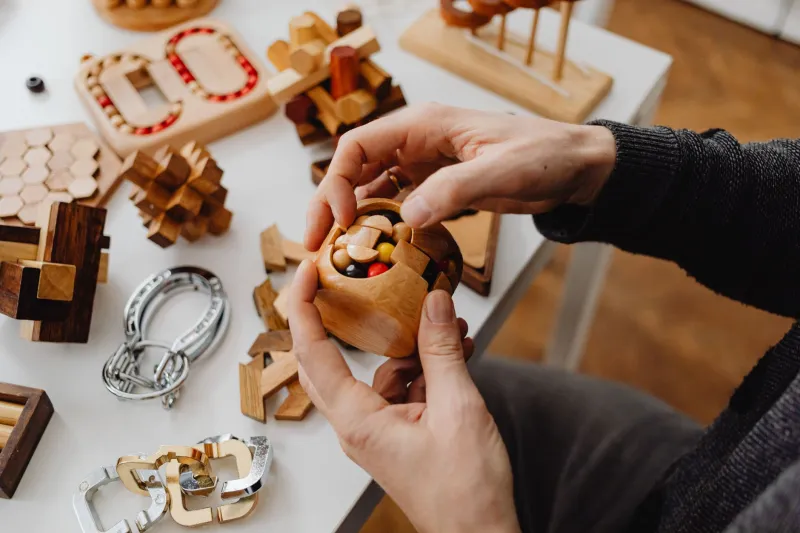
The numbers don't lie. The US escape room industry alone has grown from a handful of venues in 2012 to over 2,500 locations today. Online puzzle platforms are reporting year-over-year subscriber growth in the double digits. Puzzle subscriptions, mystery box services, and brain teaser apps are everywhere. By most measures, America is in the middle of a full-blown puzzle renaissance.
And yet, ask any serious solver what they're looking for, and you'll hear the same answer, over and over: "Something actually good."
The demand is enormous. The supply of quality content? That's a different story.
The Puzzle Boom Is Real — and Lopsided
The appetite for challenging, satisfying brain teasers has never been higher. The pandemic accelerated a trend that was already building — people stuck at home discovered (or rediscovered) puzzles, escape room kits, mystery games, and logic challenges as a way to feel mentally engaged when the world had otherwise shut down.
But the boom didn't just produce more puzzles. It produced a flood of mediocre puzzles. Platforms scrambled to meet demand. Escape room venues opened without experienced designers. Apps generated algorithmically assembled riddles that technically worked but felt hollow. The market got bigger and, in many corners, shallower.
"There's a difference between a puzzle and a good puzzle," says Jamie Okonkwo, a puzzle designer based in Chicago who has built content for escape rooms, board games, and digital platforms for over a decade. "A puzzle just has a solution. A good puzzle makes you feel something — frustration, curiosity, that specific kind of joy when things click. That second thing is genuinely hard to manufacture at scale."
What Actually Makes a Puzzle Satisfying?
This is the question that separates the great designers from everyone else. And the answer, it turns out, is less about difficulty and more about design intention.
According to Okonkwo and other experienced creators, the hallmarks of a truly satisfying puzzle include:
Fair difficulty. The puzzle should feel hard but not arbitrary. Every clue should be discoverable through logic, not luck. Solvers should be able to look back at the answer and think "I could have gotten that" — not "how was I supposed to know that?"
A moment of genuine surprise. The best puzzles have an "aha" moment — a point where the solution recontextualizes everything you've seen before. That shift in perspective is what solvers are actually chasing, even if they don't always name it.
Elegant construction. Nothing is wasted. Every element serves a purpose. Experienced solvers can feel the difference between a puzzle that was carefully crafted and one that was slapped together.
Appropriate resistance. A puzzle that's too easy isn't satisfying. Neither is one that's artificially obscured. The sweet spot — what game designers sometimes call "flow" — is a challenge that matches your skill level closely enough to keep you engaged without breaking you.
The problem is that producing puzzles with all of these qualities, consistently, at scale, requires a skill set that's genuinely rare.
The Designer Shortage Nobody's Talking About
There are thousands of puzzle creators in the US. There are far fewer truly excellent ones.
Puzzle design sits at an unusual intersection of disciplines — it requires mathematical logic, narrative instinct, psychological awareness, and a particular kind of empathy (the ability to imagine how someone who doesn't know the answer will experience the puzzle). Most people who love puzzles can solve them brilliantly. Far fewer can build them.
"Solving and designing are almost opposite skills," says Priya Mehta, who runs an online puzzle community with over 40,000 active members. "When you solve, you're following the path. When you design, you have to build the path while constantly imagining someone who can't see where it goes. That's a completely different cognitive mode."
Mehta says her community regularly debates which platforms and designers are worth following — and the consensus list is short. "There are maybe a dozen designers whose stuff we all get excited about. That's not enough to feed the appetite we have."
Platforms Are Feeling the Pressure
For digital puzzle platforms, the supply problem shows up in different ways. Some have leaned into AI-generated content to keep up with demand — with mixed results. Others have pivoted to community-sourced puzzles, which raises quality control issues. A few have invested heavily in small teams of dedicated designers, which is expensive and slow.
The platforms that seem to be winning, at least with serious solvers, are the ones that prioritize curation over volume. Less content, higher quality, more editorial intention.
"Solvers don't actually want infinite puzzles," Okonkwo observes. "They want the right puzzles. There's a huge difference. If you give someone a hundred mediocre riddles, they'll get bored and leave. Give them ten that are genuinely brilliant, and they'll come back every week."
The Escape Room Problem
In the physical escape room world, the quality gap is especially visible. The barrier to opening a venue is relatively low — rent a space, buy some props, build a few lock-based puzzles, and you're in business. But the barrier to building an experience that players rave about and return to is much, much higher.
The best escape rooms in the US — the ones with multi-month waitlists and cult followings — share a common DNA: they're designed by people who think like storytellers as much as puzzle-makers. The physical space, the narrative, the puzzle sequence, and the emotional arc are all deliberately composed. Nothing is accidental.
That level of craft takes time and expertise that most venues simply don't have. And as more venues open to capitalize on demand, the average quality of the experience gets diluted.
What Solvers Actually Want in 2024
When you ask passionate puzzle enthusiasts what they're looking for, a few themes emerge consistently:
- Novelty of mechanism — not just a new puzzle, but a new type of puzzle. Something that requires thinking in a way they haven't tried before.
- Narrative integration — puzzles that exist within a story, where the solving feels meaningful rather than arbitrary.
- Community and discussion — the ability to talk through a puzzle with others, debate interpretations, and share the experience.
- Appropriate challenge scaling — puzzles that get harder in intelligent ways, not just by adding more steps.
The gap between what solvers want and what the market is currently delivering is, by most accounts, still significant. Which is actually good news — not just for designers with real craft, but for anyone who loves a challenge.
The best puzzles are still out there. You just have to find them.
And if you're a TricksClues regular, you already know that part of the fun is the hunt.